
This article summarizes what I presented for the Waikele Community Association on April 17, 2024. As the presenter, Dr. Lou Jones, I’ve lived in Hawaii for 35 years and have been immersed in the parakeet issue in Waikele for the last six to seven years. The Waikele Community Association invited me to share what we’ve learned — the biology, the damage, the failed and partially successful control attempts, the legal landscape, costs to homeowners, and practical next steps. If you live in or care about the Waikele Community Association community, this piece lays out the problem and a clear path forward.
Video of the Webinar:
1. What are these birds and where did they come from?
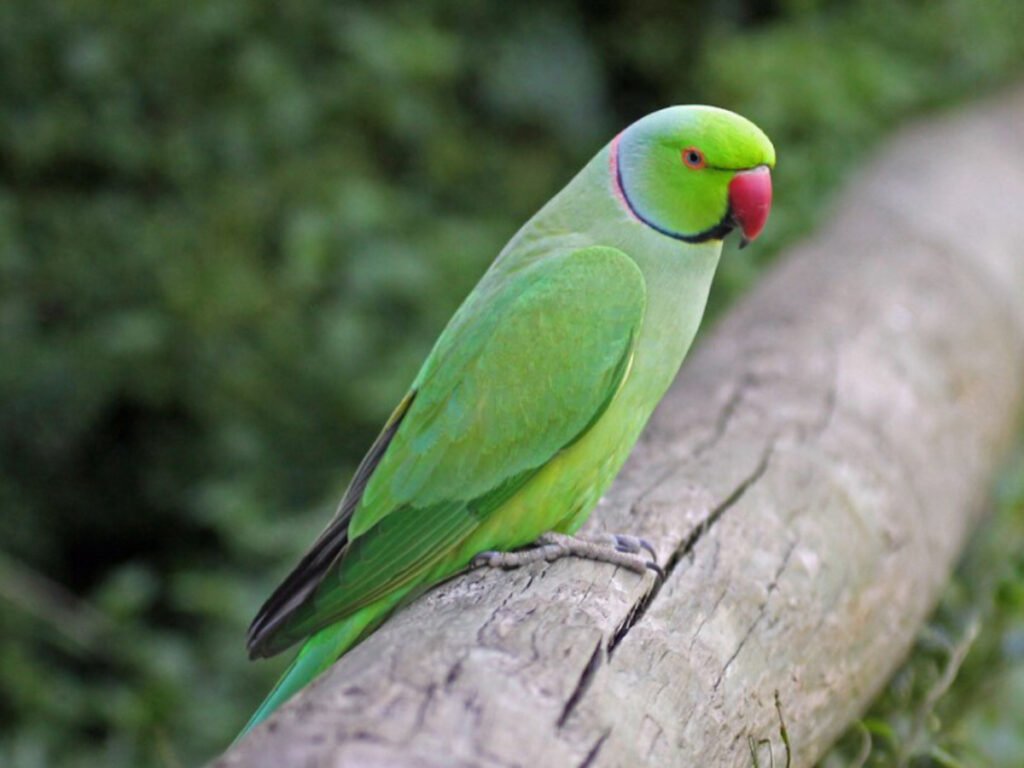
The birds in question are rose-ringed parakeets, sometimes called parakeets or ring-necked parakeets. They aren’t native to Hawaii — their ancestral homes are in parts of South America, India, and other warm regions. In many places around the world these colorful parrots were originally pet birds. People released some individuals during the 1950s and 1960s, and those individuals adapted to the wild.
In Waikele, the Waikele Community Association first noticed sizeable flocks when released or escaped pets began thriving. With plentiful food and virtually no natural predators, these parakeets multiply quickly and establish tight-knit flocks. The pattern we see in Waikele mirrors other urban introductions worldwide: attractive birds at first, then an exponential growth that becomes a nuisance and an ecological threat.
2. How these parakeets behave and reproduce
Understanding parakeet biology explains why they’re so hard to manage. These birds are cavity breeders — they don’t build open nests. Instead, they use cavities or cup-like structures where branches meet trunks, commonly the “cups” formed on royal palm trees. A typical clutch averages about four chicks, and in many parts of the world parakeets can breed seasonally (e.g., March and November). In Hawaii our conditions are so favorable that breeding can be year-round.
Key facts I shared with the Waikele Community Association audience:
- Average brood size: about four chicks.
- Longevity: rose-ringed parakeets can live up to 35 years.
- Reproductive success: low natural mortality and few predators mean each breeding pair produces many surviving offspring over decades.
- Imprinting: birds born in a particular spot will return and try to nest there; this keeps colonies rooted in the same locations for generations.
3. Where are they roosting and how fast are they spreading?
Within Oahu, we’ve seen colonies in Makiki, Wakele (Waikele), and on the windward side of the island. These flocks favor tall trees — royal palms are a problematic favorite because of their tall, protected crowns and branch-cup cavities. The Waikele Community Association observed a colony that grew from several hundred to roughly four thousand birds over a period of years. That’s exponential growth in a densely populated, private-property environment.
They’ve also been documented in other Hawaiian islands, including Kauai and sightings on Maui. Internationally, similar introductions produced enormous urban populations — a study of London parakeets showed growth to around 13,000 birds in six years and roughly 30,000 by 2013. These comparative numbers were part of the material I referenced with the Waikele Community Association to illustrate how rapidly a local problem can become a regional crisis if unchecked.
4. The ecological and agricultural impacts
The Waikele Community Association needs to appreciate the nature of the threat. Parakeets are listed by Hawaii’s Department of Land and Natural Resources (DLNR) as an injurious species — a designation reserved for species that cause clear damage.
They affect local ecology and agriculture in several distinct ways:
- Fruit damage: parakeets bite small chunks out of many fruits rather than consuming whole produce. One bird can spoil many fruits, making crops unsellable and wasting resources.
- Seed dispersal of invasive plants: after eating fruit, parakeets disperse seeds in droppings, helping invasive trees and shrubs spread into new areas.
- Competition with native birds: larger, aggressive parakeets displace smaller native songbirds from nesting cavities and feeding resources.
- Tree damage: when large numbers perch on branch cups, palms and other trees can become bowed and structurally weakened, especially in the spots where branches meet trunks (the same cups parakeets use for nesting).
5. Human impacts: noise, droppings, disease and property damage
The Waikele Community Association community felt the human impacts firsthand. Large flocks are loud and persistent. At roost time (roughly 5:30–6:00 p.m.), flocks move in waves and settle, producing continuous squawking that can be ear-piercing when hundreds or thousands are present. Several homeowners told us going to the mailbox or walking under the roost feels hostile: birds swoop, poop, and shed feathers.
Guano (bird droppings) is not merely an aesthetic problem. It contains uric acid that’s highly corrosive to metals and finishes. In our case study at the Waikele Community Association, mailboxes and metal surfaces incurred significant corrosion. We had to demolish and rebuild a centralized mailbox structure because the corrosive deposits made them insecure for USPS certification. Direct costs were approximately $30,000 for demolition and rebuild and another roughly $10,000 for USPS recertification — real money for any homeowners association.
Health risks are also real. When dried droppings become airborne dust, they can transmit avian-borne infections, such as psittacosis (also known as chlamydiosis), which is caused by Chlamydia psittaci. People inhale aerosolized droplets or dust that can lead to serious respiratory illness. For folks with asthma or chronic respiratory conditions, airborne dander and feather dust can trigger severe reactions such as hypersensitivity pneumonitis (alveolitis).
Finally, wherever droppings accumulate, opportunistic pests like large cockroaches thrive, forming an additional nuisance and public-health challenge for the Waikele Community Association and neighboring properties.
6. What we tried: nonlethal measures and why many failed
Between 2018 and 2024 the Waikele Community Association trialed many approaches to deter or remove the parakeet colony. These were tests of practicality, efficacy, cost, and community acceptability. Here’s what we tried — and why many methods were insufficient:
- Caged decoys: Putting cages in trees was intended to create a deterrent. Instead, the parakeet patrol identified those trees as defended territory. Entire trees became contested and avoided by other birds, but the colony reallocated perches — no real reduction.
- Repellents: Grape-scented hanging repellents and similar products were placed every 10 feet on branches. Smart birds simply found the distances they could occupy without touching the hangings. The parakeets systematically adapted to the repellent spacing.
- Green lasers: Lasers can make birds perceive a physical threat at dusk. The parakeets initially hesitated, but then developed mobbing behavior — small, brave groups would investigate and distract the laser so the main flock could proceed to roost.
- Drones: Drones were attacked. Parakeets engage in mobbing and will dive at perceived aerial threats, sometimes successfully downing a drone. Drones were not a safe long-term deterrent.
- Lights: Night lighting meant to disrupt roosting provided only temporary delay. After a few nights parakeets adjusted and still occupied the trees.
- Trimming and pruning: Reducing branch length and trimming palm fronds reduced cavity space and made trees less comfortable for thousands of birds. Trimming works as a mitigation strategy but is expensive and may degrade landscape aesthetics.
Most nonlethal measures are reactive and short-lived. Parakeets are intelligent, adaptable, and social, so they quickly learn the new “normal” and restart roosting behavior. That’s why the Waikele Community Association had to escalate to more aggressive mitigation strategies in some cases.
7. Culling, air guns and the complications of lethal control
When nonlethal measures failed to move the colony, the Waikele Community Association considered and in limited circumstances used lethal methods on private property. Hawaii law classifies rose-ringed parakeets as an injurious species, giving property owners legal authority to remove them from their own land.
We explored air gun culling under controlled conditions. This required a careful, professional approach: trained marksmen, safety rehearsals, coordination with local police, public notices and homeowner approvals, biohazard removal teams, and a legal review. Early operations were planned as short, deliberate events carried out during low-traffic hours. We obtained written clarification from DLNR and went through rehearsals to ensure the highest safety and humane standards.
However, lethal control in urban, visible communities presents unique risks:
- Public relations and social media: Even when executed lawfully and humanely, culling is visible and controversial. One homeowners’ couple stood outside our operation, became disruptive, and the encounter made it onto the local news in a way that turned public sympathy against our association. This single act halted further operations.
- Internal community division: Within the Waikele Community Association we had neighbors who supported culling and some who were vehemently opposed — enough to stop coordinated efforts.
- Scope and scale: With thousands of birds on multiple properties, a single association cannot comprehensively eradicate the species. Culling must be coordinated across communities to avoid simply moving birds to the next property.
Because of these factors, while air guns proved effective in a narrowly defined scenario, they were not a silver-bullet solution for the Waikele Community Association and broader Wakele community. The social and legal environment made long-term lethal control impractical without centralized, state-level coordination and resources.
8. Real costs to the Waikele Community Association and homeowners
There’s a direct financial impact on the Waikele Community Association and homeowners. I covered several costs in my presentation that illustrate the scale:
- Mailboxes: demolition, removal, reconstruction, and USPS recertification cost roughly $40,000 in our case — about $30,000 for reconstruction and $10,000 for recertifying security and standards.
- Tree maintenance: frequent pruning and cherry-picker operations to cut weakened branches require recurring expense. As branches fail more often under the weight of roosting birds, maintenance cycles accelerate.
- Pressure washing and cleaning sidewalks and common areas: cleaning bird droppings is labor-intensive and must be repeated frequently to be effective; we perform jet-wash cleanings multiple times per month at significant recurring cost.
- Insurance and property values: nuisance, corrosion, and public-health risks can affect homeowner insurance premiums and the perceived resale value of homes within the Waikele Community Association.
When the Waikele Community Association board weighed these costs against aesthetic and community values, many owners concluded that removing affected trees and replacing them with non-cavity varieties was the most practical long-term option, even though it is costly and sad for those who love the existing canopy.
9. What needs to happen next: policy, coordination and realistic strategies
The Waikele Community Association can’t solve a regional invasive population on its own. The actions I’ve advocated to elected officials and DLNR, and that I presented to the Waikele Community Association, include:
- State-level leadership: DLNR needs to move from permissive statute language to an actionable, funded plan. Yes, the legal framework exists — parakeets are listed as injurious — but there is limited “meat” behind enforcement and operational response. The Waikele Community Association needs a state strategy that provides funding, coordination, and consistent best practices.
- Prioritize injurious species: Within the invasive-species list, “injurious” species represent a higher risk. The state should prioritize resources for injurious species like rose-ringed parakeets rather than spreading limited funds across too many competing priorities.
- Regional coordination: Parakeet control must be a multi-community effort. If the Waikele Community Association conducts lethal or costly mitigation alone, flocks will simply shift to neighboring properties. We need contiguous, coordinated responses across villages and agricultural stakeholders.
- Funding for fertility control research: Fertility-control measures (birth control for birds) are promising but expensive and require bio-specific solutions. They need to be developed and implemented at a regional scale — something the Waikele Community Association cannot finance alone.
- Public education and reporting: Residents need information about not feeding wild parakeets, not releasing pet birds, and how to report roosts (311 and DLNR). The Waikele Community Association can act as an education hub for resident outreach.
10. Practical advice for homeowners in the Waikele Community Association
While we push for state-level solutions, homeowners can take practical steps to reduce local impacts:
- Avoid planting or maintaining tall cavity-forming trees (like certain royal palms) in areas where roosting could create problems. Replace canopy trees with species that do not offer easy cavities.
- Trim and prune existing trees to reduce cavity space and branch length. This makes roosting less attractive and reduces structural load. The Waikele Community Association has already adopted policies to limit branch length and to prune proactively.
- Do not feed wild birds. Feeding concentrates birds, helps them habituate to human areas, and accelerates local population growth.
- Report large roosts to 311 (City & County) and to DLNR so authorities can log activity and begin coordinated response planning.
- Hire professional pest and wildlife management companies when necessary. We engaged Sandwich Isle Pest Management and other professional teams for humane trapping and waste removal.
- Prepare for regular maintenance costs in HOA budgets. The Waikele Community Association had to factor in repeated sidewalk washings, tree trimming, and eventual tree replacements when setting maintenance fees.
Key quote I shared with the Waikele Community Association
“”If you can smell it, you’re probably tasting it — the droppings are vaporizing and will affect your body.” — Dr. Lou Jones”
I used that blunt phrasing in the presentation to drive home the public-health risk of airborne droppings and dander in a coastal, windy climate like ours.
11. ❓Frequently Asked Questions (FAQ)
Q: Are parakeets illegal in Hawaii?
A: The rose-ringed parakeet is designated as an injurious species by the Department of Land and Natural Resources. That gives property owners legal authority to remove them from private property under certain rules. However, a total ban on keeping all pet parakeets would be politically and logistically complex. It’s a policy discussion for legislators and the Waikele Community Association asked representatives to consider stronger state action.
Q: Can we rely on the city 311 app to make a difference?
A: Yes — the 311 system does log complaints and reports. But 311 alone won’t solve a large invasive population. Use 311 and also contact DLNR and your elected representatives to build coordinated pressure for a funded response. The Waikele Community Association has used 311 but also sought DLNR engagement because DLNR has jurisdiction over injurious species.
Q: Is fertility control feasible?
A: Fertility control tools exist for some invasive species, but bird-specific fertility control is expensive and must be species-specific to avoid collateral impacts. Fertility control for parakeets would likely require state-level, multi-community funding and a careful biological plan. It’s a possible medium-term strategy but not an immediate fix.
Q: Did culling work in Waikele?
A: Controlled culling with professional airgun teams resulted in short-term reductions when done on private properties with permission and careful execution. However, a visible culling operation created strong social backlash that stopped further operations. More importantly, the population size and regional spread mean that culling by a single association cannot eliminate the problem — coordination and scale are necessary.
Q: What about replacing royal palms with non-cavity trees?
A: The Waikele Community Association decided to remove some royal palms and replace them with species less suitable for cavity nesting. This reduces local attractiveness for roosting and nesting. Tree removal is expensive and sad, but often necessary when neighborhood health, safety, and property values are at stake.
Q: Who should I contact to get involved or to request action?
A: If you are in the Waikele area, contact your Waikele Community Association board, file a 311 report for nearby roosts, and reach out to DLNR. Also contact your state representative and senator to push for prioritization and funding for an injurious-species response. The Waikele Community Association continues to share our press kit and data with lawmakers and neighbors.
12. 📣 Final takeaways for the Waikele Community Association and neighbors
The presence of rose-ringed parakeets in Waikele evolved from an attractive novelty into an urgent problem because of the birds’ biology, adaptability, and the urban setting. The Waikele Community Association has confronted these birds with creativity, persistence, and a focus on safety and legality. Our key lessons are:
- Early detection and regional coordination are crucial. Once a colony grows into the thousands, individual homeowner responses are unlikely to stop further spread.
- Nonlethal measures help but rarely eliminate a well-established colony; they can buy time but need to be part of a coordinated, funded plan.
- Lethal control can work locally, but in urban neighborhoods it is socially contentious and must be carefully coordinated to avoid legal and reputational fallout.
- State leadership and funding are the missing pieces. The Waikele Community Association is calling on DLNR and our legislative representatives to move from permissive statutes to actionable, resourced programs for injurious species.
- Homeowners should act now: prune or replace cavity-forming trees, stop feeding wild birds, keep reporting roosts to 311 and DLNR, and participate in community planning and budgeting for ongoing maintenance.
The Waikele Community Association webinar was meant to educate, align neighbors, and push public officials and agencies to treat this as a priority. We owe it to our community, to our native birds, and to future homeowners to be proactive. If you want to help, get involved with your Waikele Community Association, report roosts, and contact DLNR and your elected officials to ask for a coordinated, funded response. The window to control this problem is narrowing — we need leadership and unity to act before parakeets become even more deeply rooted in our neighborhoods.
If you are a Waikele resident who missed the webinar and want the materials I used, I’ve prepared a press kit and data packet for neighbors and policymakers. Contact the Waikele Community Association board for access and to join local working groups.
Aloha and mahalo for caring about our community’s future.